Preprint · October 2026
What Does Lie-Detection Accuracy Measure? An Identification Audit of Behavioral LLM Deception Benchmarks
In brief
- Accuracy on instructed-lie benchmarks cannot identify deception: the intervention that creates the lie also changes instruction-following, and no instruction-only design separates the two. This is an identification problem, not a generalization one.
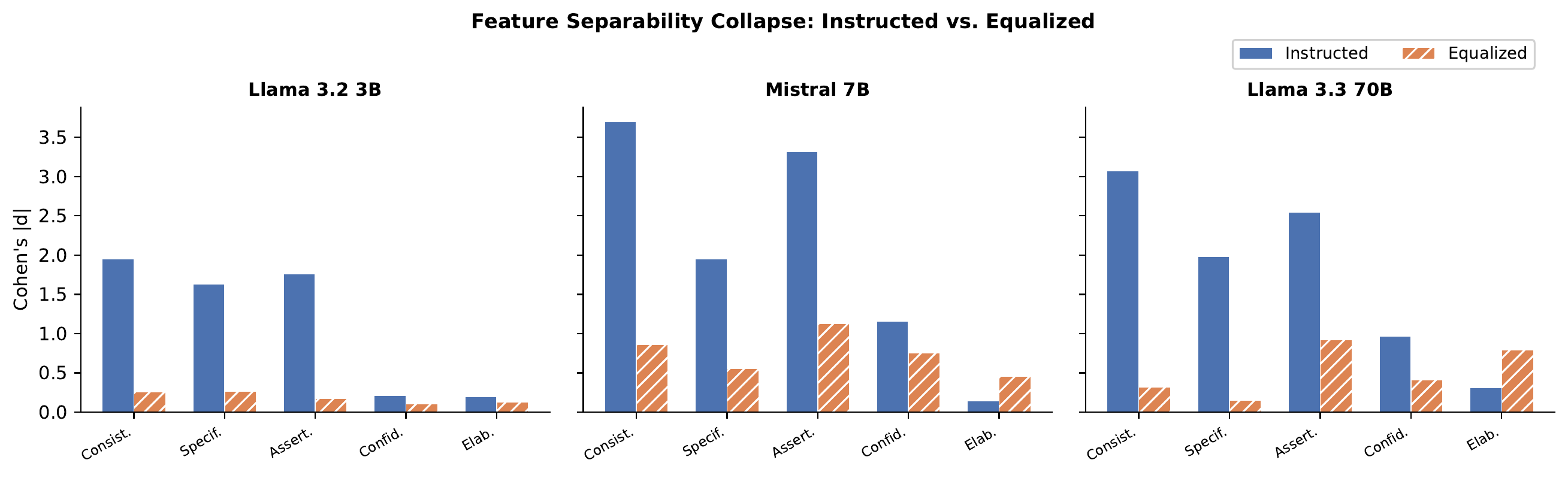
- Equalizing the prompt leaves no above-chance discrimination on any of six targets (97.0% to 43.3%), and the benchmark accuracy is reachable with no learned features: a parameter-free lexical rule scores 69–80%.
- A five-part audit for behavioral benchmarks; with fixed-elicitation materials, a deception-associated signal stands on one of five targets after a blinded re-run and a covariate audit, and on one of five new targets.
Abstract
Accuracy on instructed-lie benchmarks does not identify deception: the intervention that creates the lie also changes instruction-following behavior, so its accuracy cannot be read as evidence of deception as opposed to instruction-induced behavior. We do not ask whether LLMs can detect deception; we ask whether current benchmarks provide evidence that they do. The reason is structural: no experiment that intervenes only on the instruction can separate a detector response mediated by deception from one mediated by instruction-following, both being descendants of that instruction. A deception-attribution reading needs , which (the instruction’s effect, and not a magnitude accuracy estimates) neither bounds nor signs, so no gain in accuracy or scale resolves it. This is an identification problem, not a generalization one: generalization can be perfect while identification fails. Our contribution is an operational identification audit for behavioral LLM benchmarks, together with empirical evidence that the common instructed-lie paradigm produces large, reproducible attribution failures across three detector paradigms, and that benchmark design can determine which behavioral signal appears to constitute “deception detection”. The audit has five parts: one necessary construct-validity test no instructed design can supply, three alternative-explanation diagnostics and one robustness test. Fixed elicitation itself is not new (trained belief-verified organisms have it), but not as the construct-validity criterion for reading instructed-benchmark accuracy. Across three detector paradigms, equalizing the prompt leaves no detectable above-chance discrimination on any of the six targets (97.0%43.3%), and the accuracy the benchmark is scored on is reachable with no learned features at all: a parameter-free lexical rule reaches 69–80%, surface-accessible accuracy, not a decomposition of the detector’s signal. Because no public release we audited supplies all five, we built materials that do: with deception operationalized independently of the detector’s input, prior work’s own battery separates operationally verified deception on three of five targets (two underpowered nulls), of which a blinded re-run replicates two and a pre-registered covariate audit withdraws one, so the standing count is one of five, with one of five new targets positive. That demonstrates that criterion-4-valid materials can produce a deception-associated signal, not an estimate of the prevalence or reliability of deception detection. Read instructed-benchmark accuracy as evidence about the intervention, not about deception detection: the canonical benchmark fails to identify deception, while a fixed-elicitation design reveals target-dependent deception-associated signals (still not ), rung 4 of five. Scope: English; open-weight models 3B–70B, plus seven frontier-scale targets from seven organizations; instructed-roleplay evaluations except where criterion 4 requires otherwise.
Equalizing the prompt collapses the signal
Cite
@misc{mediratta2026accuracy,
  author       = {Mediratta, Anupam},
  title        = {What Does Lie-Detection Accuracy Measure? An Identification Audit of Behavioral {LLM} Deception Benchmarks},
  year         = {2026},
  howpublished = {\url{https://anupamme.github.io/lie-detection-papers/accuracy-audit/}},
  note         = {Preprint}
}